

A consultancy agreement is the contract you use when you hire, or work as, an independent consultant in the UK. It sets the scope, fee, ownership, data duties, tax position, and exit rules so you are not relying on loose emails.
What is a consultancy agreement? A consultancy agreement is a contract for services between you and a self-employed consultant, contractor, limited company, or advisory business. It is not the same as an employment contract because it should define project work, deliverables, consultancy payment, tax status, IP rights, confidentiality, liability, and termination without creating an employee role. In 2026, it should also cover AI use, first-party data, and GEO content outputs.
|
Number |
Item |
Category |
Fix |
|
1 |
Vague scope |
Deliverables |
List outputs, dates, formats, and acceptance tests |
|
2 |
Unclear fee |
Payment |
State invoice triggers, due dates, VAT, and expenses |
|
3 |
IR35 ignored |
Tax |
Add status facts and match real working practice |
|
4 |
IP missing |
Ownership |
Use a written assignment or licence |
|
5 |
Data unclear |
GDPR |
Name controller, processor, access, and deletion rules |
|
6 |
AI unchecked |
2026 risk |
List approved tools and human review duties |
|
7 |
GEO undefined |
Content |
Define answer-engine assets, schema, and source rules |
|
8 |
Exit weak |
Disputes |
Add notice, handover, and final payment terms |
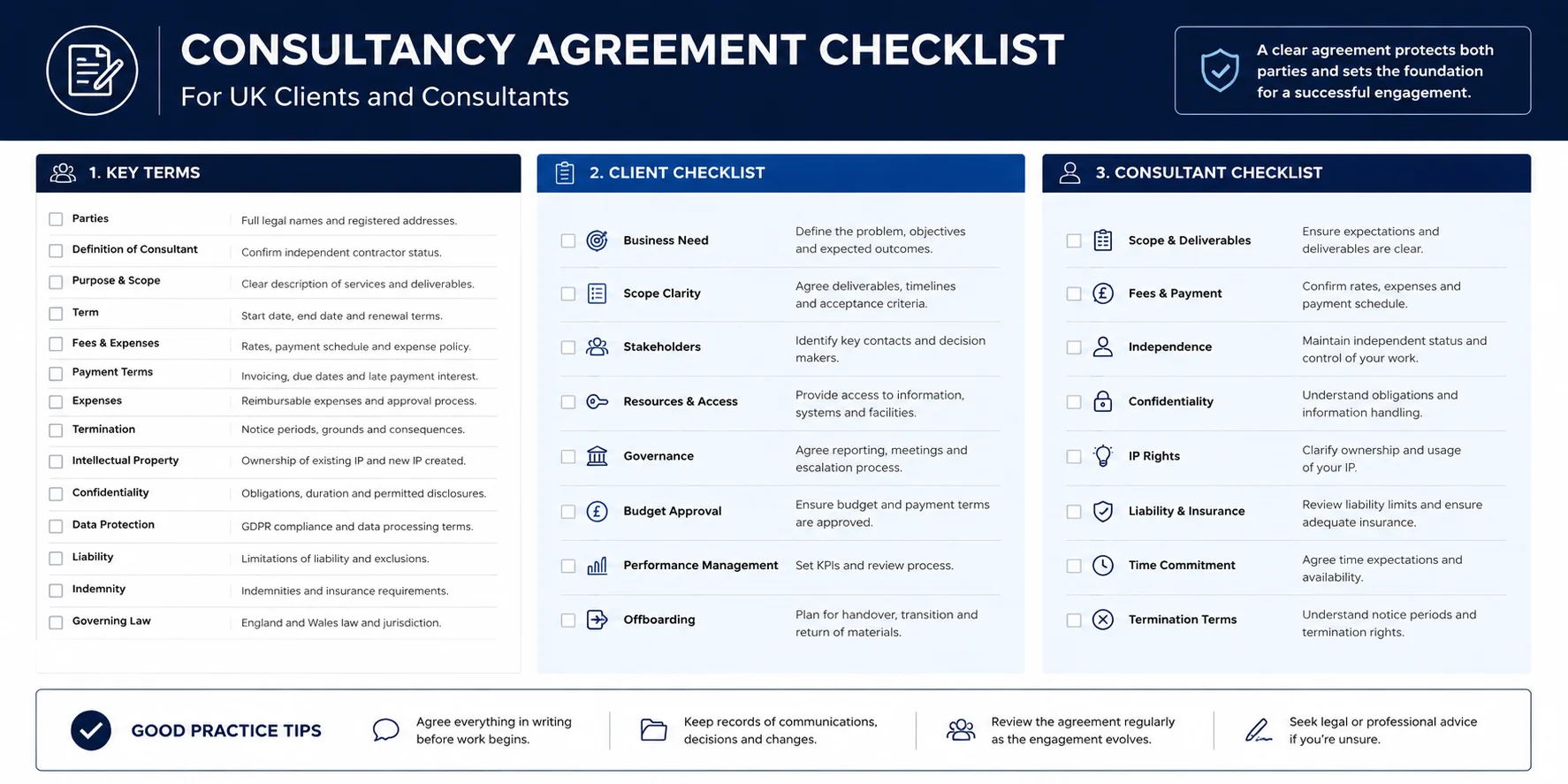
A consultancy agreement should include the parties, services, deliverables, fees, expenses, IR35 position, IP, confidentiality, data protection, liability, termination, and UK governing law. The best agreement is specific enough that someone outside the project can check if the work was done. My view is that plain wording beats legal-looking wording every time.
The mechanism is simple: measurable terms reduce arguments. For example, replace “provide marketing support” with “deliver one 12-page marketing audit, one 60-minute call, and one action plan by 30 September 2026.” The market is large, so clarity matters: GOV.UK reported 5.7 million private sector businesses in 2025, with SMEs forming 99.85% of the business population.
Action: attach a statement of work. Include milestones, client duties, acceptance criteria, and a change request rule.
IR35 matters because the tax position can change if you work like an employee through an intermediary. You should not treat IR35 as a label you can fix by wording alone. My opinion is direct: your working practice matters more than a nice heading.
The mechanism is status testing. If the client controls your hours, blocks substitution, gives employee-style duties, and expects ongoing personal service, the agreement may not match reality. HMRC guidance says off-payroll rules can apply where a worker provides services through an intermediary, and the responsibility for deciding status depends on the client type and contract facts.
Action: document substitution, control, equipment, financial risk, project basis, and no employee benefits. Also, keep evidence, such as invoices, project briefs, and change approvals.
Consultancy payment terms should say what you charge, when you invoice, when payment is due, and what happens if payment is late. A strong consultancy payment clause tells you exactly when money is earned. My view is that “payment on completion” is too risky unless completion is clearly defined.
The mechanism is cash-flow certainty. A clear clause protects both sides because the client knows the trigger and the consultant knows the due date. For late commercial payments, GOV. The UK says the statutory interest rate for business-to-business debt is 8% plus the Bank of England base rate, unless the contract sets a different rate.
Action: state deposits, milestones, day rates, retainers, VAT, expenses, purchase order needs, and disputed invoice steps.
|
Payment model |
Best for |
Example |
|
Fixed fee |
Clear output |
£2,000 for an audit |
|
Day rate |
Flexible advice |
£600 per day |
|
Retainer |
Ongoing access |
£1,200 per month |
|
Milestone |
Longer work |
30%, 40%, 30% |
Your agreement should say who owns the intellectual property, when it transfers, and what the consultant can reuse. If IP is not written down, you may not own what you think you bought. My firm opinion is that every creative, software, content, design, and strategy project needs an IP clause.
The mechanism is default ownership. GOV.UK says a person working under a contract for services will usually retain copyright unless there is a contrary contractual agreement. For example, a designer may deliver a logo, but the editable files, concepts, and reuse rights need clear wording.
AI makes this sharper in 2026. UK government research says 16% of UK businesses currently use at least one AI technology, so AI-assisted reports, code, drafts, prompts, and images should be expected.
Action: separate client materials, consultant background tools, and final deliverables. State whether ownership transfers only after full payment.
Original insight: The most common weakness in drafts I see is not the IP clause itself. It is the missing asset list, such as source files, prompts, datasets, editable files, code access, and final PDFs.
Your agreement should state what confidential information and personal data the consultant may access, why they can use it, and when they must delete it. Data clauses decide who can use customer information and who carries breach risk. My opinion is that one generic confidentiality sentence is not enough in 2026.
The mechanism is role clarity. The ICO says organisations must decide whether they are a controller, processor, or joint controller when processing personal data. For example, a consultant analysing your CRM list on your instructions may be a processor, but using the data for their own purpose can change the role.
The risk is serious. The ICO says the higher maximum UK data protection penalty can be £17.5 million or 4% of total annual worldwide turnover, whichever is higher.
Action: list data categories, approved systems, security duties, breach notice timing, retention, deletion, audit rights, and subprocessor rules.
You should add clauses for approved AI tools, banned data inputs, human review, source checks, first-party data limits, and deliverables. A 2026 consultancy agreement should allow useful AI work but block uncontrolled data use. My view is that older templates miss this risk.
The mechanism is traceability. If a consultant uses AI to create analysis, content, or code, you need to know what data was entered, what sources were checked, and who reviewed the output. GOV.UK research found that among AI adopters, 85% use natural language processing and text generation, which means text-based outputs need governance.
You can use a consultancy agreement template UK as a starting point, but you should adapt it before signing. A template gives structure, not judgment. My view is that a cheap template becomes expensive when it misses the one clause your project needs.
The mechanism is a mismatch. A fixed-fee design template may not suit a 6-month advisory retainer, and a local consultant may need different risk wording from a larger corporate client. GOV.UK reported that 75% of UK private sector businesses had no employees aside from owners, while SMEs still provided 16.9 million jobs, or 60% of total business employment.
Action: check five points before signing: deliverable, acceptance test, data touched, IP ownership, and early exit.
You should fix vague scope, missing IP wording, weak payment terms, unclear data roles, no IR35 thinking, unlimited liability, and no exit process. Most consultancy disputes start from silence, not complex legal wording. My opinion is that every sentence should answer who, what, when, how much, who owns it, or what happens next.
The mechanism is evidence. If there is a dispute, the contract, emails, drafts, invoices, and meeting notes will show what each side expected. For example, “support launch” is weak, while “attend two launch calls and deliver a launch checklist” is clear.
Action: read the draft once as the client and once as the consultant. Mark vague wording and replace it with measurable terms.
Yes. Small projects still involve money, scope, ownership, deadlines, and risk.
No. A consultant is usually independent, while an employee works under employment terms and receives employment rights.
They often mean the same thing. Consultant contract is the everyday phrase, while agreement of consultancy sounds more formal.
Use hourly or day rates when the work is uncertain. Use fixed fees when the output is clear.
Yes, if the termination clause allows it. State notice, payment for work done, data return, and handover duties.
Not always. A person working under a contract for services usually keeps copyright unless the contract says otherwise.
Yes. Disclose AI use where it affects confidentiality, data protection, accuracy, originality, or source reliability.