Running a business is exciting, but every opportunity comes with responsibility. Whether you are hiring a freelancer, partnering with another company, selling products, or providing professional services, every deal should be supported by a well-written agreement. That is where small business contracts in the UK become essential.
Many business owners believe contracts are only necessary for large corporations. In reality, small businesses often face greater financial risks because one misunderstanding or an unpaid invoice can have a significant impact. A carefully written business contract protects both parties, sets clear expectations, and reduces the chances of costly disputes.
Think of a contract as a roadmap rather than a legal obstacle. Instead of focusing only on legal language, a strong business agreement explains responsibilities, deadlines, payment expectations, and solutions if something goes wrong. It gives everyone confidence because each party knows exactly what has been agreed.
For businesses operating in the UK, using professionally drafted small business contracts in the UK is one of the smartest investments you can make. This guide explains the ten clauses every contract should include and offers practical tips to help you create stronger agreements that protect your business.
Related Resources
The Importance of Key Clauses
Every successful commercial agreement is built on clarity. Missing even one important clause can create confusion, disagreements, unexpected expenses, or damaged business relationships.
A complete contract should:
- Clearly define each party’s responsibilities.
- Explain payment expectations.
- Protect confidential information.
- Reduce legal uncertainty.
- Provide solutions if disputes occur.
- Build trust between both parties.
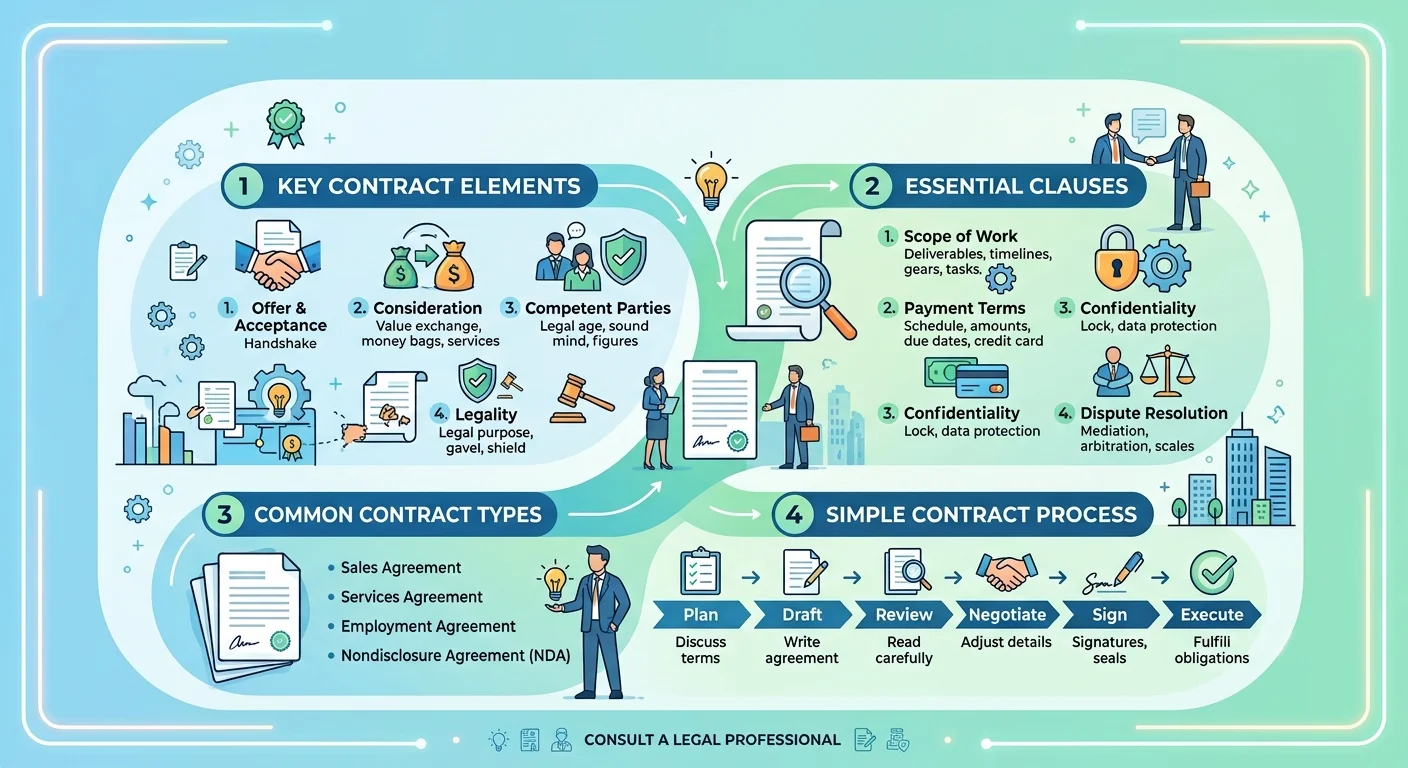
Below are the ten clauses that should appear in almost every small business contracts uk document.
Clause 1: Payment Terms
Payment disputes are among the most common business problems. A payment clause removes uncertainty by explaining exactly how and when payments should be made.
Include:
- Total contract value
- Payment schedule
- Accepted payment methods
- Late payment penalties
- Interest on overdue invoices
- Deposit requirements
For example, instead of writing “Payment due soon,” state, “Payment is due within 14 days of invoice date.”
Clear payment terms protect cash flow and strengthen every business contract.
Clause 2: Confidentiality
Businesses regularly exchange sensitive information such as customer lists, pricing models, financial records, software, and marketing strategies.
A confidentiality clause explains:
- What information is confidential
- Who can access it
- How it should be protected
- How long does confidentiality continue after the agreement ends
Including confidentiality in small business contracts in the UK helps safeguard valuable business information and customer trust.
Clause 3: Termination
Not every partnership lasts forever. A termination clause explains how either party can legally end the agreement.
It should cover:
- Notice period
- Reasons for immediate termination
- Outstanding payments
- Return of company property
- Final obligations
Without this clause, ending a business agreement can become stressful and expensive.
Clause 4: Scope of Work
One of the biggest reasons projects fail is unclear expectations.
The scope of work should describe:
- Services provided
- Deliverables
- Project milestones
- Completion dates
- Items excluded from the agreement
For service providers, this clause prevents “scope creep,” where clients request extra work without additional payment.
Every commercial agreement should clearly define what is included and what is not.
Clause 5: Responsibilities of Both Parties
Contracts work best when everyone understands their role.
Specify:
- Client responsibilities
- Supplier obligations
- Required approvals
- Communication expectations
- Resource commitments
When responsibilities are clearly documented, projects move faster, and misunderstandings decrease.
Strong small business contracts in the UK always explain who is responsible for each task.
Clause 6: Intellectual Property Rights
If your business creates original work, intellectual property protection is essential.
Examples include:
- Logos
- Website designs
- Software
- Written content
- Product designs
- Marketing materials
Your contract should explain:
- Who owns the newly created work
- When ownership transfers
- Whether work can be reused
- Licensing rights
Without this clause, ownership disputes can arise long after the project ends.
Clause 7: Liability and Indemnity
Unexpected problems happen in business.
A liability clause limits financial responsibility if something goes wrong.
An indemnity clause explains who will cover losses caused by negligence, legal claims, or breaches of contract.
This section helps reduce financial risk while making responsibilities clear for everyone involved.
Including liability protections strengthens every business contract.
Clause 8: Dispute Resolution
Even well-written agreements cannot prevent every disagreement.
Instead of immediately going to court, many businesses agree on alternative dispute resolution methods.
Options include:
- Negotiation
- Mediation
- Arbitration
- Court proceedings as a final option
A dispute resolution clause saves time, money, and valuable business relationships.
Many experienced professionals consider this one of the most valuable sections in small business contracts in the UK.
Clause 9: Force Majeure
Some events are completely outside anyone’s control.
Examples include:
- Natural disasters
- Major power failures
- Government restrictions
- Pandemics
- Severe weather
- National emergencies
A force majeure clause explains what happens if these unexpected events prevent either party from meeting their obligations.
Without it, businesses may unfairly face penalties for circumstances they could never control.
Clause 10: Governing Law and Jurisdiction
Businesses often work with suppliers and customers in different locations.
A governing law clause states which country’s laws apply to the agreement and which courts will handle legal disputes.
For businesses operating within the UK, this clause should clearly reference the applicable legal jurisdiction.
Including governing law creates certainty and avoids confusion if disagreements arise later.
Every professional commercial agreement should contain this clause.
Related Resources
Real-World Example
Imagine a small digital marketing agency in Manchester agrees to build a website for a local retailer. The owner accepts the project through emails without using proper small business contracts uk.
Halfway through the project, the client requests additional pages, new branding, and online booking features. The agency completes the work but sends a larger invoice. The client refuses to pay, arguing that those extras were included.
If the agency had included a detailed scope of work, payment schedule, change request process, and termination clause within its business agreement, both parties would have known exactly what was included. The disagreement could have been avoided, saving weeks of frustration and protecting the business relationship.
This simple example shows how strong contracts prevent expensive misunderstandings before they happen.
Tips for Drafting Effective Contracts
Creating reliable small business contracts in the UK does not mean filling pages with complicated legal language. The best contracts are clear, practical, and easy to understand.
Follow these best practices:
- Write in plain English whenever possible.
- Define important terms before using them repeatedly.
- Avoid vague wording such as “reasonable time” without explanation.
- Use headings and bullet points to improve readability.
- Review every agreement before signing.
- Update contracts regularly as your business grows.
- Keep signed copies securely stored.
- Ensure both parties receive identical versions.
- Record amendments in writing rather than relying on verbal agreements.
- Seek professional legal advice for complex or high-value transactions.
Quick Contract Checklist
Before signing any business contract, ask yourself:
- Are payment terms completely clear?
- Does the scope of work cover every deliverable?
- Are confidentiality obligations explained?
- Can either party terminate fairly?
- Are intellectual property rights defined?
- Does the contract limit liability appropriately?
- Is there a dispute resolution process?
- Does it include force majeure protection?
- Is the governing law identified?
- Have both parties reviewed and agreed to every clause?
If the answer is yes to every question, your agreement is far more likely to protect your business effectively.
Conclusion
Every successful business is built on trust, but trust alone is not enough. Well-written small business contracts in the UK provide clarity, reduce misunderstandings, and protect both parties throughout every stage of a professional relationship.
Whether you are working with customers, suppliers, contractors, or business partners, including the right clauses transforms a simple document into a powerful business tool. Payment terms, confidentiality, termination rights, scope of work, responsibilities, intellectual property, liability, dispute resolution, force majeure, and governing law each play an important role in creating a reliable business agreement.
Strong contracts are not about expecting problems; they are about preventing them. By investing time in creating comprehensive small-business contracts in the UK, you improve communication, strengthen professional relationships, reduce legal risks, and build a more resilient business. Every carefully prepared commercial agreement becomes another step toward long-term stability, sustainable growth, and greater confidence in every deal you make.