

Running an agency is exciting, but growth also brings legal risks. One client dispute, a vague payment clause, or an unclear scope of work can quickly become an expensive problem. That is why every successful agency should have a well-drafted agency contract that protects both parties and sets clear expectations from day one.
Many agency owners focus on winning new business but overlook the importance of documenting their working relationships properly. Whether you operate a marketing agency, recruitment agency, sales agency, or consultancy, having a comprehensive agreement reduces misunderstandings, strengthens trust, and provides legal protection when disputes arise.
Agency contracts are legally binding agreement that defines the relationship between a principal and an agent. It establishes what services will be provided, how authority is delegated, payment arrangements, responsibilities, confidentiality obligations, and the process for resolving disputes.
For agency business owners, effective agency contracts serve as more than a legal document. It becomes the foundation of every successful client relationship.
A professionally drafted agency agreement should clearly explain:
Understanding agency contracts UK is particularly important because local regulations, commercial practices, and legal precedents influence how contracts are interpreted.
Without a clear contract of agency, clients may assume responsibilities that were never agreed upon, while agencies risk delivering additional work without compensation.
A carefully prepared agency contract provides far more than legal compliance. It creates confidence for both parties and supports sustainable business growth.
Some of the biggest advantages include:
Every agreement defines responsibilities from the beginning. Clients know exactly what is included, while agencies avoid endless revisions and unexpected requests.
Late payments are one of the biggest frustrations for agency owners. Strong agency contracts includes payment schedules, late payment clauses, deposit requirements, and cancellation fees that improve financial stability.
Clients often view agencies with detailed documentation as more reliable and experienced. A comprehensive agent agency agreement demonstrates professionalism and reduces uncertainty before work begins.
Every business relationship carries risk. A properly written contract limits liability, clarifies ownership of deliverables, and establishes procedures for handling disagreements before they escalate.
Ironically, contracts don’t create distrust; they build confidence. When expectations are documented, communication becomes easier and misunderstandings become less common.
Understanding agency law helps agency owners appreciate why contracts matter.
The law of agency governs relationships where one party acts on behalf of another. Depending on the arrangement, an agency may have authority to negotiate, represent, or make decisions within agreed boundaries.
A comprehensive contract of agency helps establish:
If disagreements arise, courts frequently examine the written agency contract before considering verbal discussions or assumptions.
For UK businesses, understanding agency contracts UK means recognising that carefully written agreements often prevent litigation altogether.
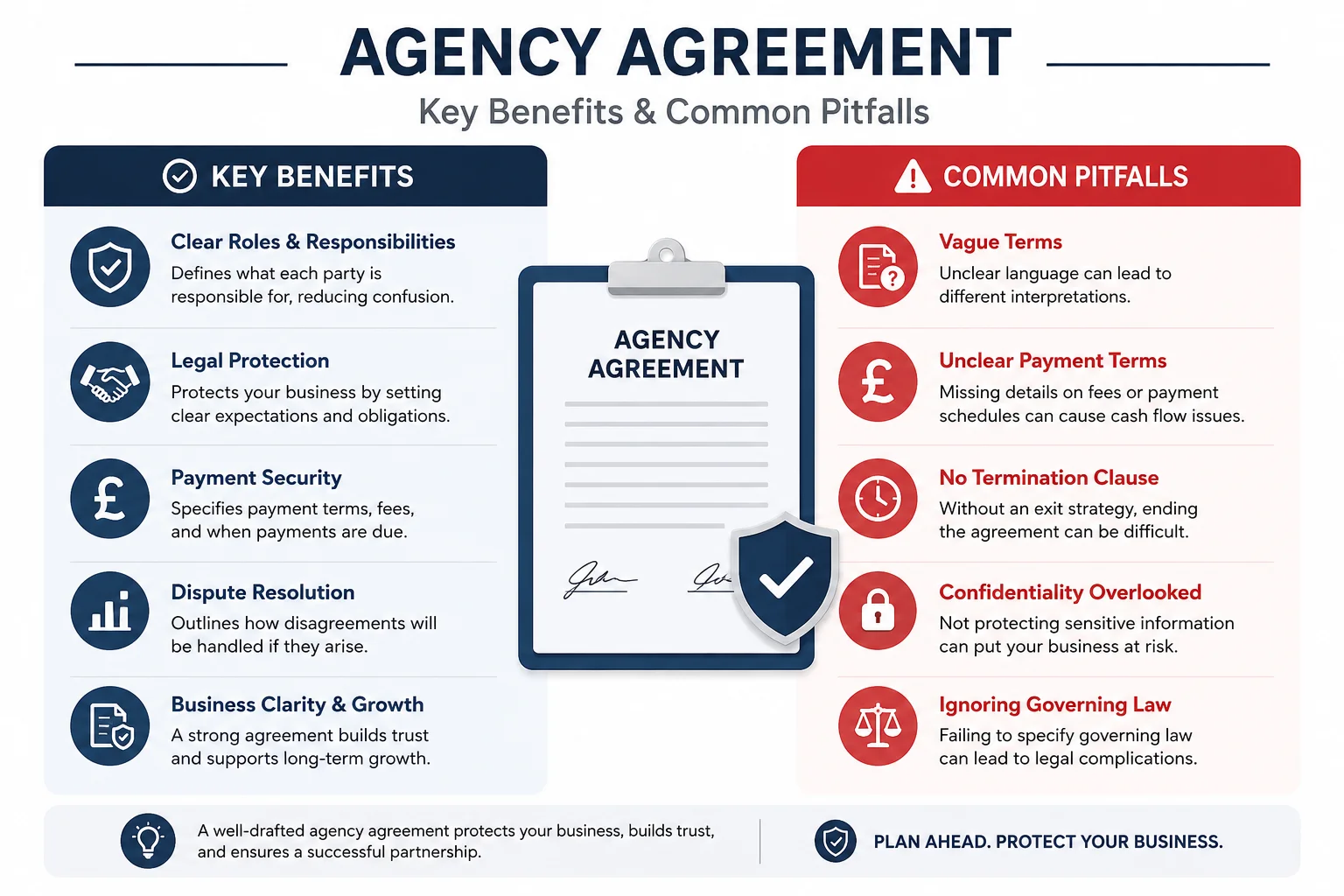
Many agencies only discover weaknesses in their agency contracts after a dispute has already occurred.
Avoid these common mistakes.
Statements like “ongoing marketing support” create confusion.
Instead, define:
The more specific the agency agreement, the easier it becomes to manage expectations.
Who owns creative work?
Without clear wording in the contracts, ownership disputes can become complicated.
Specify:
Never rely on invoices alone.
A strong contract should define:
Relationships sometimes end.
A good agreement explains:
Businesses operating under agency contracts in the UK should ensure agreements comply with relevant commercial laws and industry regulations.
Seeking professional legal advice can prevent expensive mistakes later.
Creating an effective contract of agency doesn’t require unnecessary complexity. It requires clarity.
Start by identifying the commercial objectives of both parties.
Next, build your agency contracts around practical business operations instead of generic templates copied from the internet.
A strong agreement should include:
Identify every legal entity correctly.
Explain exactly what will and won’t be delivered.
Include:
Protect client information, internal processes, pricing models, and business strategies.
Clarify ownership before work begins.
Limit financial exposure where legally appropriate.
Specify mediation, arbitration, or court jurisdiction.
Businesses using agency contracts UK should identify the governing jurisdiction within the agreement.
Regular contract reviews are equally important. As your agency grows, your agency contracts should evolve to reflect new services, technologies, pricing models, and legal developments.