

Whether you’re signing a business deal, hiring a contractor, or agreeing to provide services, understanding the basics of UK contract law can save you from costly disputes and legal headaches.
Many people assume that any promise or handshake creates a binding agreement. In reality, contract law in the UK requires specific legal elements for an agreement to become enforceable. Questions about the legally binding meaning, types of contract, British contract law, and contractual agreement law often arise when individuals and businesses want certainty that their agreements will stand up in court.
At its core, a contract is a legally enforceable agreement between two or more parties.
Under British contract law, a contract does not always need to be written down. Verbal agreements can be legally binding if they meet the required legal criteria. However, written contracts are generally easier to prove and enforce.
The primary purpose of contract law is to ensure that parties who voluntarily enter agreements fulfil their obligations. If one party fails to perform their part of the bargain, the law provides remedies such as damages or specific performance.
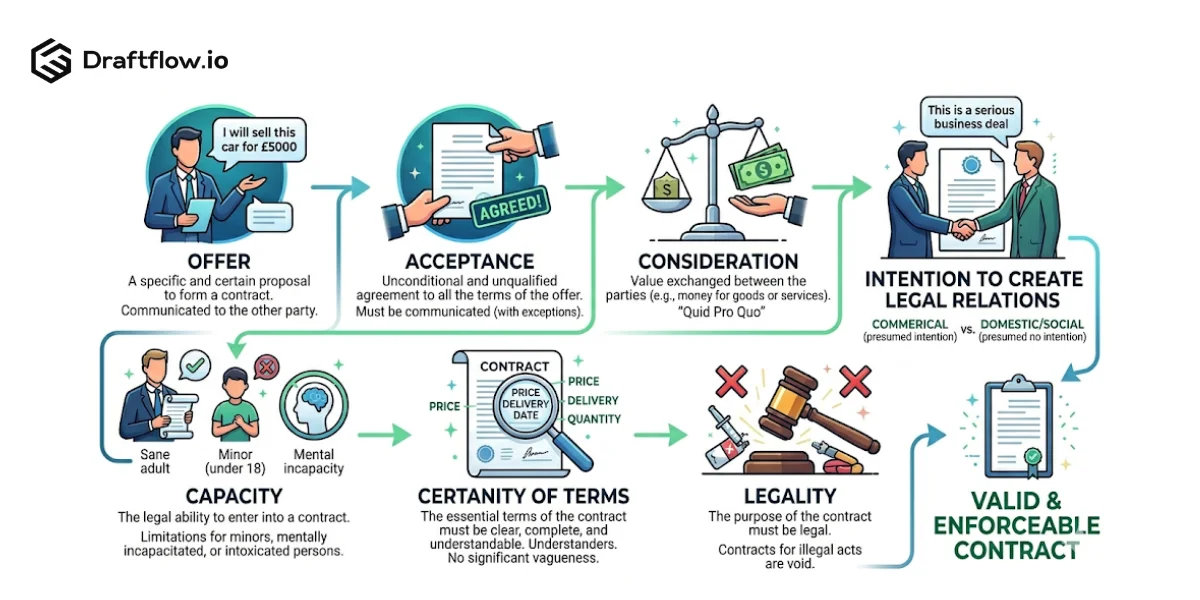
The seven essential elements of a valid contract are:
Without these components, a contract may be unenforceable or invalid.
Contracts affect almost every aspect of modern life.
You encounter contracts when:
A strong understanding of UK contract law basics helps you:
Misunderstandings often arise when contract terms are unclear. Knowing what makes a valid contract reduces the risk of disagreements.
Understanding your legal position allows you to identify breaches and seek appropriate remedies when necessary.
Clear contracts establish expectations, responsibilities, and timelines, creating stronger professional relationships.
Businesses that understand contractual agreement law are less likely to enter problematic agreements that create financial or legal exposure.
Let’s examine each element in detail.
An offer is a clear proposal made by one party to another.
The offer must demonstrate a willingness to enter into a contract on specific terms.
For example:
A graphic designer offers to create a company logo for £500, with delivery within seven days.
The offer must be precise enough that the other party can simply accept it.
A statement such as:
“I might be interested in selling my car.”
is not an offer because it lacks certainty.
Acceptance occurs when the other party agrees to the offer exactly as presented.
Acceptance must be:
If the recipient changes any terms, they are making a counter-offer rather than accepting the original proposal.
For example:
Offer: “I’ll sell you my laptop for £600.”
Response: “I’ll buy it for £550.”
This is not acceptance. It is a new offer.
Consideration refers to something of value exchanged between the parties.
Each side must give or promise something.
Examples include:
Without consideration, most agreements cannot become enforceable contracts.
For instance:
If someone promises to give you £1,000 as a gift, no consideration exists because you are not providing anything in return.
Not every agreement is intended to create legal obligations.
The law distinguishes between:
In commercial settings, courts generally presume that parties intend legal consequences.
For example:
A supplier and retailer entering a distribution agreement are clearly creating legal obligations.
However, if friends agree to meet for dinner, the arrangement is not normally considered legally binding.
Parties must have the legal ability to enter a contract.
Capacity generally requires:
Certain agreements involving minors may be unenforceable unless they concern necessities such as food, clothing, or education.
Businesses must also ensure that the individuals signing contracts have the authority to act on behalf of the organisation.
A contract must contain clear and understandable terms.
Courts cannot enforce agreements if critical terms are vague or incomplete.
Key terms often include:
For example:
“We’ll work together and sort out payment later.”
This creates uncertainty and may not be enforceable.
Clear contracts reduce ambiguity and make enforcement much easier.
A contract must involve lawful activities.
Courts will not enforce agreements that involve:
For example, a contract involving unlawful business activities would be void from the outset.
Even if all other contract elements exist, illegality prevents enforcement.
Consider a common business scenario.
A company hires a freelance web developer.
The parties agree that:
Let’s evaluate the seven elements:
Element | Present? |
Offer | Yes |
Acceptance | Yes |
Consideration | Yes |
Intention | Yes |
Capacity | Yes |
Certainty | Yes |
Legality | Yes |
The agreement is likely enforceable under British contract law.
If the developer fails to deliver, the company may have legal remedies available.
Even experienced business owners make avoidable errors.
Verbal contracts can be valid, but proving their terms is often difficult.
Written agreements provide stronger evidence.
Unclear wording creates confusion and increases the likelihood of disputes.
Every important obligation should be stated clearly.
People frequently sign contracts without understanding their obligations.
Always review:
Many people misunderstand the legally binding meaning and believe all promises create enforceable obligations.
In reality, legal enforceability depends on whether all contract elements exist.
Certain industries require additional contractual protections or compliance obligations.
Businesses should ensure agreements satisfy all applicable regulations.
Understanding UK contract law basics is only the first step. Following best practices can significantly improve contract quality.
Written agreements provide clarity and reduce evidential disputes.
Even simple arrangements benefit from written confirmation.
Each party should understand:
Dispute resolution provisions can save substantial time and legal costs.
Common options include:
Store:
These documents may become crucial evidence if disagreements arise.
Businesses should review standard contracts periodically to reflect legal developments and changing commercial needs.
Various types of contracts serve different purposes, including:
Selecting the appropriate contract structure helps ensure legal effectiveness and commercial success.
Understanding UK contract law basics is essential for anyone entering into agreements in the UK. Every enforceable contract relies on seven core elements: offer, acceptance, consideration, intention to create legal relations, capacity, certainty, and legality.
Whether you’re a business owner, freelancer, employee, or consumer, recognising these principles helps you make informed decisions, reduce legal risks, and protect your interests. Review your agreements carefully, document important terms in writing, and seek professional legal advice when dealing with complex arrangements. Strong contracts create stronger relationships, and that starts with understanding the fundamentals.
A valid contract generally requires offer, acceptance, consideration, intention to create legal relations, capacity, certainty of terms, and legality. These principles form the foundation of UK contract law basics and determine whether an agreement is enforceable.
No. Many verbal agreements are enforceable under British contract law. However, written contracts are easier to prove and provide clearer evidence of the agreed terms.
People often use the phrase “legally binding meaning” when asking whether an agreement creates enforceable obligations. The correct legal term is “legally binding,” meaning the parties can be compelled by law to fulfil their contractual duties.
Common types of contracts include employment contracts, service agreements, sales contracts, partnership agreements, tenancy agreements, and non-disclosure agreements. Each serves a different legal and commercial purpose.
Understanding UK contract law basics helps businesses create stronger agreements, minimise disputes, protect revenue, and comply with contractual agreement law requirements. Well-drafted contracts provide certainty and support long-term business growth.