
A contract worth thousands of pounds can now be drafted in minutes by AI. That speed is transforming how businesses work. But it also raises an important question: can a legally binding AI contract uk actually exist, or is AI-generated paperwork legally risky?
The short answer is yes, AI can help create contracts that are legally binding in the UK. However, the answer comes with important legal and practical conditions.
Many business owners, startups, HR teams, and freelancers already use AI tools to draft agreements, supplier contracts, employment documents, and terms of service. Yet confusion remains around whether contracts produced by artificial intelligence carry the same legal force as documents written by solicitors.
Before discussing AI, it helps to understand a simple legal truth:
UK law does not require a contract to be written by a human solicitor to be valid.
A contract becomes legally binding when core legal requirements are met.
Under UK contract law, most agreements need:
If these elements exist, the agreement can usually be enforced.
This means the law focuses less on who drafted the document and more on whether the agreement satisfies legal requirements.
That distinction is central to understanding the legally binding AI contract UK debate.
Yes, but with an important clarification.
AI itself does not enter into contracts. People and businesses do.
AI tools can:
But the legal responsibility remains with the contracting parties.
If two parties agree to an AI-generated contract and the agreement satisfies UK legal requirements, the contract can be fully enforceable.
In practice, this means:
A contract drafted by AI can be legally binding in the UK if valid consent and legal requirements are present.
The document’s enforceability depends on the agreement not the software used to create it.
AI-powered legal drafting has expanded rapidly because traditional contract preparation can be slow and expensive.
Businesses increasingly use AI for:
The appeal is obvious.
AI delivers speed, accessibility, and cost efficiency.
For small businesses without in-house legal teams, this can significantly reduce administrative burdens.
A startup founder who once waited days for draft revisions can now create a first version in minutes.
That convenience explains why the legally binding AI contract UK question matters more than ever.
UK law has already adapted to digital contracting.
The UK generally recognises:
Courts have repeatedly shown that substance matters more than format.
An agreement formed via email, website click, or digital signature can still be enforceable.
The UK government’s legal and judicial guidance has also supported the legitimacy of electronic signatures in many commercial contexts.
This legal environment creates strong foundations for AI-assisted contracts.
However, there is an important distinction:
Digital contracts are recognised. AI autonomy is a separate issue.
The law accepts contracts created with technology. It does not necessarily treat AI as an independent legal party.
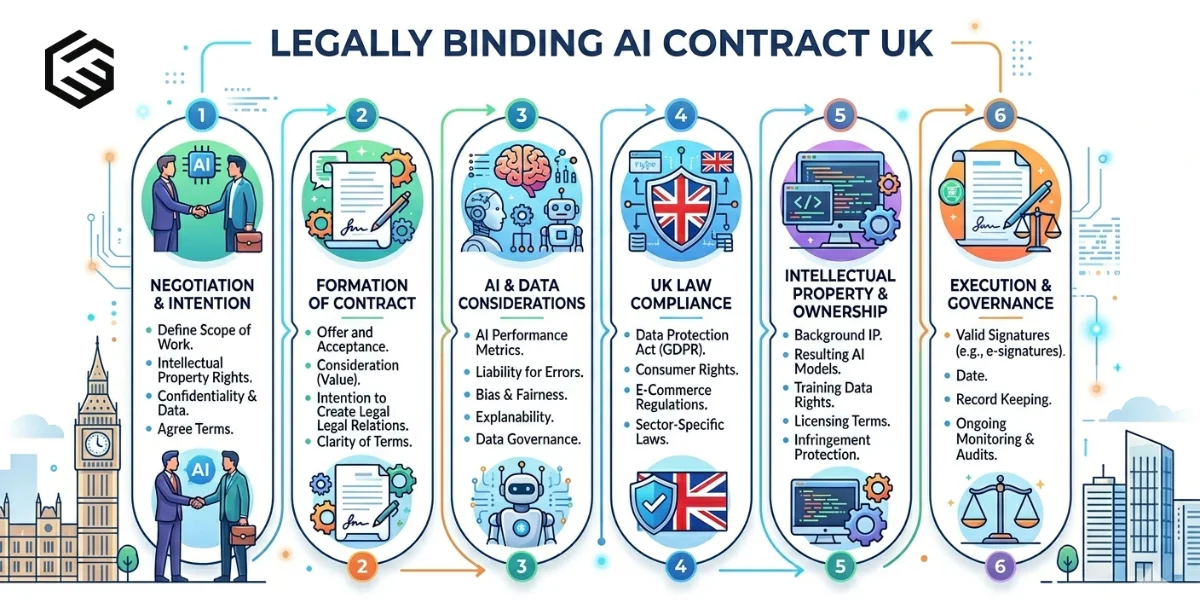
A legally binding AI contract in the UK depends on several practical factors.
AI can draft terms, but humans still approve them.
If parties knowingly accept AI-generated wording, courts generally assess the agreement like any other contract.
Approval may occur through:
Without genuine consent, enforceability becomes weaker.
AI sometimes generates vague or contradictory language.
Courts dislike uncertainty.
If contract terms are unclear, enforcement may fail.
Common problems include:
A contract generated quickly still needs legal precision.
Some contracts face additional legal rules.
Examples include:
AI cannot override statutory requirements.
A contract failing mandatory legal standards remains problematic regardless of how efficiently it was produced.
A business may use AI internally, but only authorised individuals can legally bind the organisation.
If someone lacks authority, the agreement may face a challenge.
This remains true whether the document is written by:
Imagine a UK ecommerce company hiring a freelance developer.
The company uses AI to draft a service agreement covering:
Both parties review the draft.
They negotiate one clause regarding revisions and then sign electronically.
Would the agreement be valid?
Most likely yes.
The AI drafted the wording, but:
In this scenario, the legally binding AI contract UK standard is satisfied.
Now consider a different example.
AI generates a contract with conflicting payment terms and missing IP ownership clauses. Neither party reviews it carefully.
A dispute later emerges.
The problem is not that AI wrote the contract.
The problem is poor drafting and a lack of review.
One of the biggest misconceptions involves signatures.
Many people assume AI contracts need handwritten signatures to be enforceable.
That is outdated thinking.
UK law commonly accepts electronic signatures.
These may include:
For most commercial contracts, electronic execution is acceptable.
This matters because AI workflows usually integrate with digital signing tools.
Businesses can therefore:
This creates efficient contracting processes while maintaining legal validity.
Still, some specialised transactions require additional formalities.
Property transfers and certain deeds may involve stricter execution requirements.
Legal review remains important where regulations are complex.
AI offers efficiency but not perfection.
Businesses should understand the risks.
AI systems sometimes invent legal references or inaccurate provisions.
This phenomenon, often called AI hallucination, creates serious legal exposure.
Examples include:
Blind reliance is dangerous.
Laws evolve.
An AI model trained on older information may generate outdated wording.
This is particularly risky in:
Regular review is essential.
AI may draft technically correct language while missing business realities.
Contracts are not merely legal documents.
They manage relationships and risk.
Human judgment remains indispensable.
Businesses should also assess data handling practices.
Uploading sensitive commercial information into AI systems raises questions around:
Contract drafting should align with internal data policies.
The better question is:
How should businesses use AI responsibly?
The most effective approach combines:
AI efficiency + human oversight + legal review
AI works exceptionally well for:
Human expertise works best for:
This hybrid model is already common across legal and commercial teams.
AI is not replacing legal professionals.
It is changing how legal work is performed.
If a dispute arises involving AI-generated contracts, courts generally focus on familiar legal questions.
They ask:
Notice what is missing.
The court is unlikely to ask:
“Did AI write this?”
Instead, the relevant issue is:
“Is this a valid contract under UK law?”
That legal perspective reinforces why the legally binding AI contract UK discussion is ultimately about contract principles, not technological fear.
Businesses using AI should follow practical safeguards.
Never sign without human review.
AI accelerates drafting but should not replace verification.
Choose tools with:
Free tools may not provide sufficient safeguards.
Maintain:
These documents help prove agreement if disputes arise.
Complex contracts deserve specialist review.
This includes:
Legal advice costs far less than litigation.
AI contracting is still evolving.
We are moving toward systems that:
Yet one principle remains stable:
Contract law protects agreements between people and organisations.
Technology changes drafting methods, but legal fundamentals endure.
The future is not solicitor versus AI.
It is lawyers and businesses using AI more intelligently.
So, can AI create legally binding contracts in Britain?
Yes, AI can help create contracts that are legally enforceable in the UK, provided traditional legal requirements are met, and parties knowingly agree to the terms. The software itself is not the legal actor. Human consent, clarity, authority, and compliance remain decisive.
The legally binding AI contract UK question is therefore less about whether AI is legal and more about whether businesses use it responsibly.
If you are using AI to draft contracts, treat it as a powerful assistant, not a substitute for legal judgment. Review carefully, understand the terms, and seek professional legal advice for important agreements before signing.