
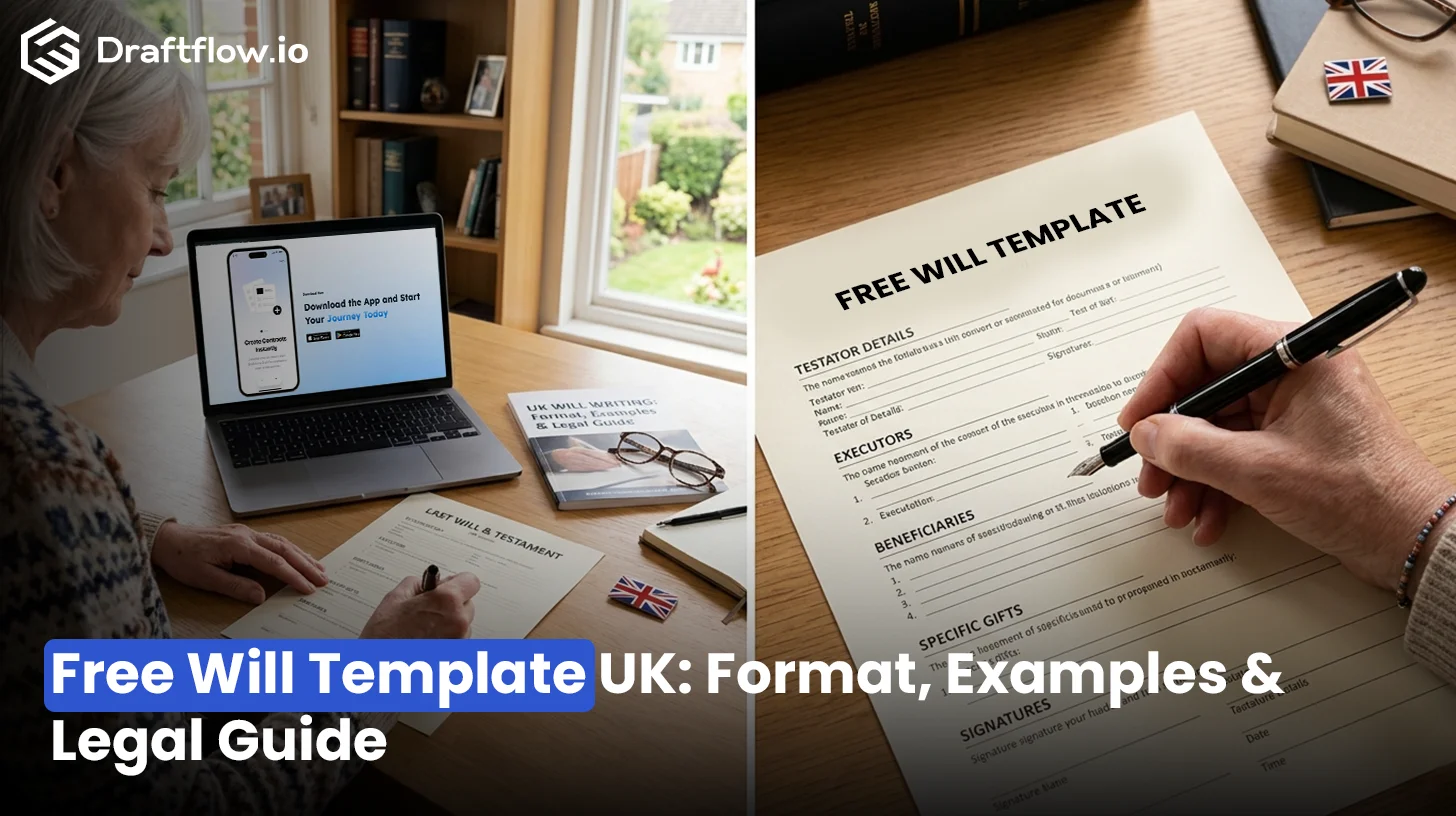
You’ve worked hard for everything you own. Your home, your savings, your business, your personal belongings. And yet, over 60% of UK adults don’t have a valid will in place.
It’s not that people don’t care. It’s that writing will feel complicated, expensive, or simply something to deal with “later.” But later has a habit of never arriving and dying intestate (without a valid will) in England or Wales means the government decides who gets what, not you.
The good news? Getting started is far simpler than most people think. A will template UK gives you a clear, structured starting point. And in 2026, modern tools make it easier than ever to draft, organise, and store your documents securely without booking a solicitor for every step.
This guide walks you through everything you need: what a will template looks like, how to format one correctly, real examples, and how to make sure yours is legally valid under English and Welsh law.
A will template is a pre-formatted document that guides you through the key sections of a legally valid last will and testament. Think of it as a structured framework where you fill in the specifics, and the template ensures you don’t miss anything critical.
In England and Wales, a valid will must meet specific legal requirements under the Wills Act 1837. Getting those requirements wrong, even on a free will template, can render your entire document invalid.
Here’s why using a proper template matters:
Before filling in any sample will and testament UK template, you need to understand the legal requirements. A will is only valid in England and Wales if:
These aren’t optional guidelines. Missing any one of these steps can invalidate the entire document.
Important: Scottish law differs from English and Welsh law. This guide covers wills in England and Wales only.
Here is the standard format for a will used across England and Wales. Every section below should appear in your document.
This is the opening statement. It identifies you, confirms you are of sound mind, and revokes any previous wills.
Example:
“I, [Full Name], of [Address], being of sound mind and body, hereby revoke all former wills and testamentary dispositions previously made by me and declare this to be my last will and testament.”
An executor is the person responsible for carrying out the instructions in your will. You can appoint one or two executors. Choose someone trustworthy: a spouse, sibling, or close friend.
Example:
“I appoint [Full Name] of [Address] to be the Executor of this my Will. If [Full Name] is unable or unwilling to act, I appoint [Full Name of Substitute] of [Address] as substitute Executor.”
If you have minor children, this section names who will care for them if both parents die.
Example:
“I appoint [Full Name] of [Address] as guardian of my minor children in the event that my spouse/civil partner is unable to act.”
This section lists any specific items or amounts of money you want to leave to named individuals or organisations.
Example:
“I give to my sister, [Name], my gold watch. I give to [Charity Name], registered charity number [XXXXX], the sum of £500.”
After specific gifts, the “residuary estate” is everything that remains. This is usually the largest part of your estate.
Example:
“I give the residue of my estate, both real and personal, to my spouse [Name], absolutely. If my spouse does not survive me by 30 days, I give the residue to my children in equal shares.”
This is where you and your two witnesses sign. All three of you must be present at the same time.
Example:
“Signed by the above-named Testator as their last will in the presence of us both, who in the Testator’s presence and in the presence of each other have hereunto subscribed our names as witnesses.”
Testator | Witness 1 | Witness 2 |
Signature: _______ | Signature: _______ | Signature: _______ |
Full name: _______ | Full name: _______ | Full name: _______ |
Date: _______ | Address: _______ | Address: _______ |
Below is a short example of a will in UK , a straightforward estate. Names and details are illustrative only.
LAST WILL AND TESTAMENT OF JAMES HENRY WALKER
I, James Henry Walker, of 14 Birch Lane, Leeds, LS6 2PQ, being of sound mind and memory, hereby revoke all former wills and codicils previously made by me and declare this to be my last will and testament, made this 1st day of March 2026.
Executor: I appoint my wife, Sarah Anne Walker, of the same address, as sole Executor of this Will. Should she be unable to act, I appoint my brother, David Paul Walker, of 8 Maple Avenue, York, YO1 3TT.
Guardian: In the event that my wife and I both die before our children reach the age of 18, I appoint my sister, Helen Margaret Walker, of 3 Oak Street, Harrogate, HG1 5BN, as guardian of our minor children.
Specific Gifts:
Residuary Estate: I give the remainder of my estate to my wife, Sarah Anne Walker, absolutely. Should she predecease me, the residue shall be divided equally between my children.
Signed by James Henry Walker as his last will and testament on the date first written above, in the presence of the undersigned witnesses.
Testator Signature | Witness 1 | Witness 2 |
J.H. Walker | R. Ahmed | P. Chen |
01/03/2026 | 15 Park Road, Leeds | 22 Hill Close, Leeds |
Using a free will template England or Wales document is perfectly fine for straightforward estates but it has limits. Here’s an honest breakdown:
Tip: If your estate involves property in multiple countries, a trust, business ownership, or potential inheritance tax issues (estates above £325,000), always consult a qualified solicitor or will-writing specialist.
Option | Cost | Speed | Legal Review | Storage | Best For |
Free Online Template | Free | Minutes | No | Self-managed | Simple, single estates |
Solicitor | £150–£300+ | Days–Weeks | Yes | Paper copy | Complex estates |
Will Writing Service | £50–£150 | Hours–Days | Limited | Varies | Mid-complexity |
Digital Platform (e.g. DraftFlow) | From £19.99/mo | Minutes | AI-assisted | Encrypted vault | Professionals, businesses |
Ask yourself these three questions:
Writing the will is only half the job. Where you keep it matters enormously.
Many people store their will in a drawer at home and tell no one. That creates real problems:
Better options include:
This is where tools like DraftFlow’s Secure Contract Vault become genuinely useful. Rather than leaving important documents in a physical drawer, DraftFlow offers enterprise-grade encrypted storage, accessible from any device via iOS or Android. Your documents are organised by type, always accessible, and never at risk of being lost in a house move.
DraftFlow is best known as an AI contract maker trusted by over 10,000 UK professionals but its features extend well beyond business contracts. Here’s how it supports anyone managing important legal documents:
“I used to email contracts as Word documents and just hoped for the best. DraftFlow changed everything I can send, track, and store everything in one place from my phone.” Freelance consultant, Manchester
Users consistently highlight the same benefits:
With a 4.8 app rating, over 250 businesses onboarded, and available on both iOS and Android, DraftFlow has become the go-to platform for professionals who take their documents seriously.
Plan | Price | Contracts + Scans | Users | Files | Best For |
Pro | £19.99/month | 50 + 50 | 1 | 50 | Freelancers, sole traders |
Advance | £39.99/month | 500 + 500 | 1 | 500 | Consultants, growing businesses |
Team | £119.99/month | 500 + 500 | 5 | 500 | Small teams and agencies |
All plans include enterprise-grade encryption, the Secure Contract Vault, and access to the full AI Contract Maker. Visit Draftflow for the most up-to-date pricing.
Whether you’re writing a will, a freelance contract, or a business agreement, these principles apply:
Writing a will is one of the most responsible things you can do for the people you care about. A will template UK gives you the structure to start but getting the details right, storing it safely, and keeping it current is what makes it truly effective.
Whether you’re using a free template as a starting point or looking for a smarter, more secure way to manage all your important documents, the key is to actually start. Today. Not later.
Ready to take control of your legal documents? Download DraftFlow today at Draftflow because protecting what matters most should never be this simple.
Yes. A handwritten will is legally valid in England and Wales, provided it meets all the requirements of the Wills Act 1837 including being signed by you in the presence of two independent witnesses who also sign the document.
No. There is no legal requirement to use a solicitor to write a will in England or Wales. However, for complex estates including business assets, overseas property, or blended families professional advice is strongly recommended.
Yes, but with care. Jointly owned property passes automatically to the surviving owner under “joint tenancy” rules, regardless of what your will says. If property is owned as “tenants in common,” your share can be left via your will. Always clarify which applies to your property.
If you die intestate (without a valid will) in England or Wales, the rules of intestacy apply. This means your estate is distributed according to a fixed legal formula which may not reflect your wishes, particularly for unmarried partners, step-children, or close friends.
Review your will after any major life event: marriage, divorce, the birth of a child or grandchild, a significant change in assets, or the death of a beneficiary or executor. As a general rule, reviewing every three to five years is sensible.
Yes. While the original signed, witnessed will should be kept as a physical document, digital copies can be stored in a secure encrypted vault for easy access and reference. Platforms like DraftFlow’s Secure Contract Vault offer enterprise-grade encryption to protect sensitive documents.
A codicil is a formal amendment to an existing will. It must be signed and witnessed in the same way as the original will. Use a codicil to make minor changes without rewriting your entire will for example, to update a specific request or change an executor.

Smart, secure, and AI-driven contract management for modern professionals. Simplify your workflow with confidence in United Kingdom.
Resources
Contact Info

Office 516 85 Dunstail Hill , Wolverhampton United Kingdom , WV6 0SR

