
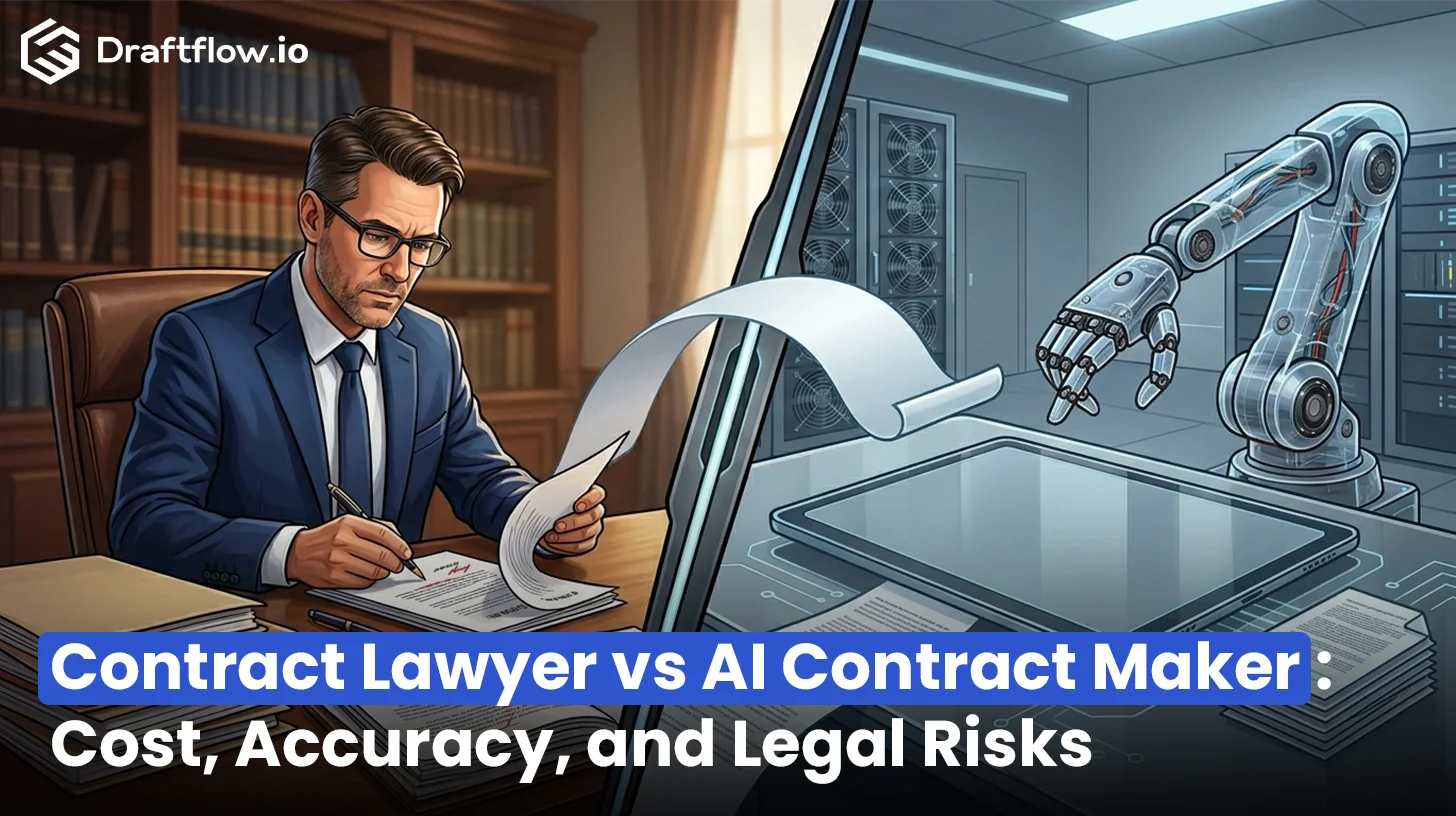
If you are choosing between a contract lawyer and an AI contract maker, AI tools now lead in cost efficiency and speed. In contrast, lawyers remain essential for high-risk legal situations.
A contract lawyer is a legal professional who drafts, reviews, and negotiates agreements to ensure they are legally valid and protect your interests.
The problem is that legal language can be complex and easy to misinterpret. A contract lawyer solves this by applying legal frameworks, case law, and jurisdiction-specific rules. According to the Law Society UK, poorly written contracts are a major cause of business disputes.
A contract lawyer is best used when legal risk is high, and mistakes would be costly.
For example, a business hiring a contract review solicitor for a partnership agreement avoided ownership conflicts by clarifying equity clauses.
Opinion: You should not skip a lawyer when contracts involve large financial or legal consequences.
An AI contract maker is software that generates agreements using templates, machine learning, and natural language processing. The issue most people face is time and cost. AI solves this by automating drafting using tools like DraftFlow. According to a McKinsey report, automation can reduce document creation time by up to 90 percent. AI contract makers work by generating legally structured documents in seconds at minimal cost. For example, a freelancer can create a complete client agreement in under five minutes without paying legal fees.
Opinion: For most routine contracts, AI is now the practical starting point.
A contract lawyer typically costs £150 to £500 per hour, while AI tools cost between free and £50 per month. The key problem is budget constraints, especially for startups and freelancers. AI removes this barrier by offering low-cost access to structured contracts. According to a Clio Legal Trends Report, legal fees are one of the top reasons small businesses avoid hiring lawyers. AI contract tools clearly win on cost efficiency and accessibility.
Example: A startup used an AI tool instead of hiring a contracts manager and saved over £3,000 in initial legal costs.
Opinion: If your goal is affordability, AI is the better choice in most situations.
A contract lawyer is more accurate in complex scenarios, but AI performs well for standard agreements. The issue is context. Lawyers apply reasoning, while AI relies on trained data and templates. A Stanford study found AI legal tools can achieve up to 77 percent accuracy in structured tasks. AI is accurate enough for standard contracts but less reliable for complex or unique cases.
Example: AI can handle a basic end-user license agreement, but a contract lawyer is better for negotiating publishing rights.
Opinion: Accuracy depends on use case, but AI is sufficient for most everyday needs.
AI contracts carry risks related to missing clauses, compliance gaps, and a lack of customisation. The main problem is that AI cannot fully interpret intent or business context. According to the UK Ministry of Justice, contract disputes have increased with digital agreements. The risk with AI is not obvious errors, but subtle gaps that appear later.
Example: A SaaS company used an AI-generated contract that lacked proper data protection terms, leading to compliance issues.
Opinion: AI is safe when used carefully, but risky when used unthinkingly.
You should use a contracts lawyer when the agreement involves high risk, legal complexity, or negotiation. The issue is underestimating contract impact. Complex agreements require legal interpretation that AI cannot fully provide. Use a lawyer when the cost of a mistake is higher than the legal fee.
Example: A business hiring a contract review solicitor for an acquisition agreement avoided major financial exposure.

AI is the better option for speed, cost efficiency, and standardisation. The problem is that traditional legal processes are slow and expensive. AI solves this by automating repetitive drafting tasks. According to Deloitte, legal automation can reduce workload by up to 30 percent. AI is the best choice for fast, affordable, and repeatable contract creation.
Example: A small agency generates all client contracts using AI and reviews them internally once a month.
Opinion: In 2026, AI should be your default tool unless the contract is complex.
The best strategy combines AI drafting with legal review. The issue is balancing efficiency and safety. AI handles speed, while lawyers provide validation. The hybrid model delivers both cost savings and legal protection.
Example: Companies now use tools like Kira Systems and Luminance to draft contracts, then consult a lawyer only when needed.
Original insight: Businesses using hybrid workflows report up to 35 percent faster contract turnaround with reduced legal costs.
Factor | Contract Lawyer | AI Contract Maker |
Cost | High | Very Low |
Speed | Moderate | Very Fast |
Accuracy | High (complex cases) | Good (standard cases) |
Legal Risk | Low | Moderate |
Accessibility | Limited | High |
Best Use | Complex contracts | Everyday contracts |
Is AI better than a contract lawyer?
AI is better for cost and speed, while lawyers are better for complex legal protection.
Can AI replace contract lawyers in 2026?
AI can replace lawyers for simple contracts but not for complex or high-risk agreements.
Are AI-generated contracts reliable?
Yes, for standard use cases, but they should be reviewed for important agreements.
When should I hire a contract review solicitor?
When dealing with complex, high-value, or legally sensitive contracts.
Can AI handle an end-user license agreement?
Yes, but legal review improves compliance and accuracy.
What does a book contract lawyer do?
They handle negotiation of rights, royalties, and publishing terms.
Do businesses still need contracts managers?
Yes, especially to oversee contract workflows and ensure compliance.