
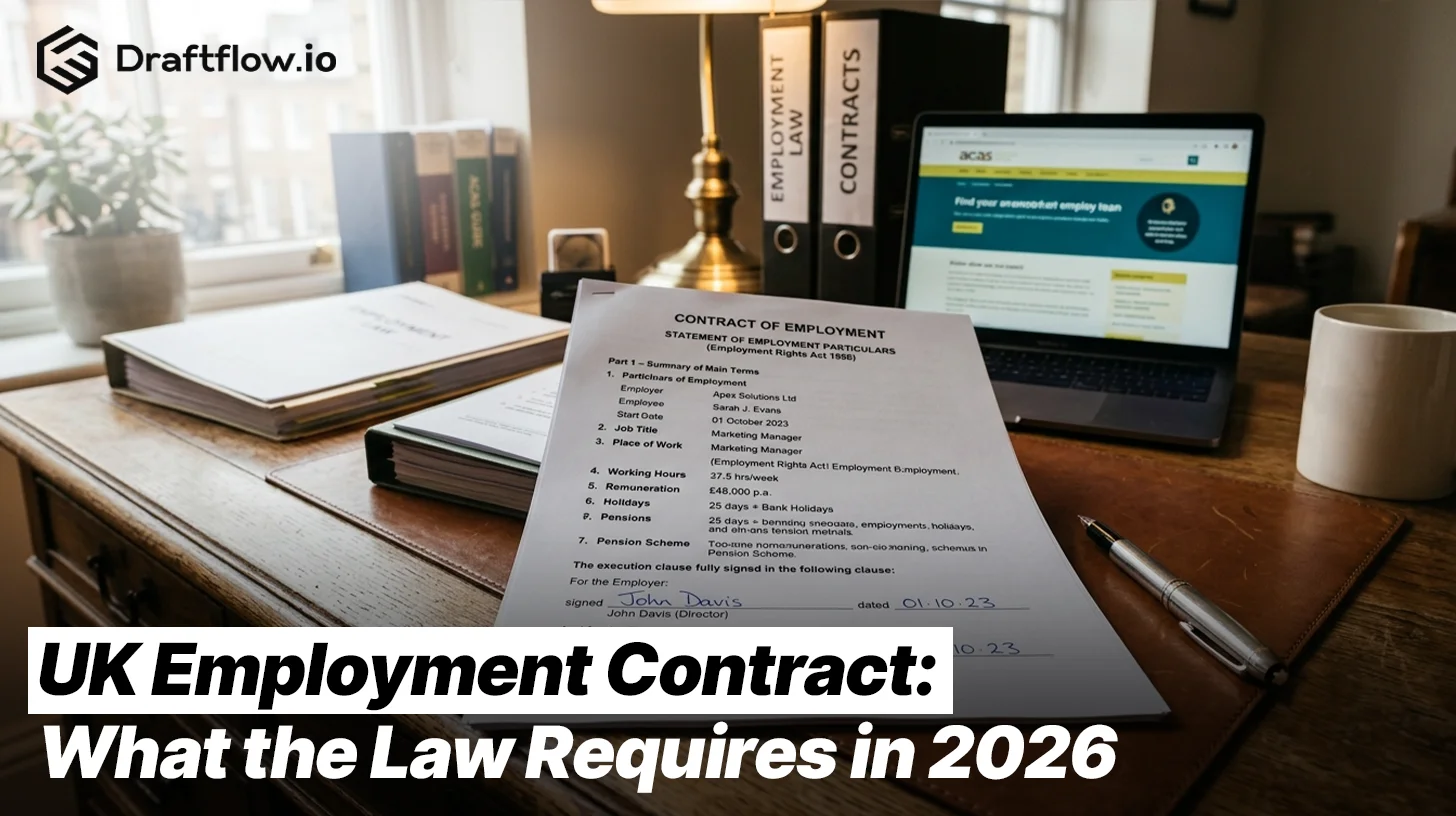
According to UK employment contract law, employers must provide each employee with a written principal statement on the first day of work and a more comprehensive statement within two months. The Employment Rights Act 2025 introduces major changes across 2026 and 2027, including day-one sick pay and parental leave rights.
Confused about what your employment contract must legally include? You’re not alone.
The rules changed. The Employment Rights Act 2025 became law on 18 December 2025, and the first wave of changes landed in April 2026. If you’re an employee, you have more rights than you did a year ago. Your old contract templates may already be outdated if you are a business owner.
This guide breaks down exactly what UK employment contract law requires in 2026. I’ll cover the documents you must provide, the risks of skipping them, and the deadlines you can’t afford to miss.
What makes a contract legally binding? Most people think it’s a signature on paper. It isn’t.
Under British contract law, an employment contract exists the moment someone accepts a job offer. A written document isn’t required for the contract to be valid. It starts as soon as the employee agrees to work for pay.
That said, written terms matter enormously. They prove what was agreed. They protect both sides when memories differ.
An employment contract covers two types of terms:
Want to go deeper on the foundations? Read my guide to understanding British contract law before you draft anything.
The biggest shake-up to UK employment contract law in years is already underway. The Employment Rights Act 2025 rolls out in stages across 2026 and 2027.
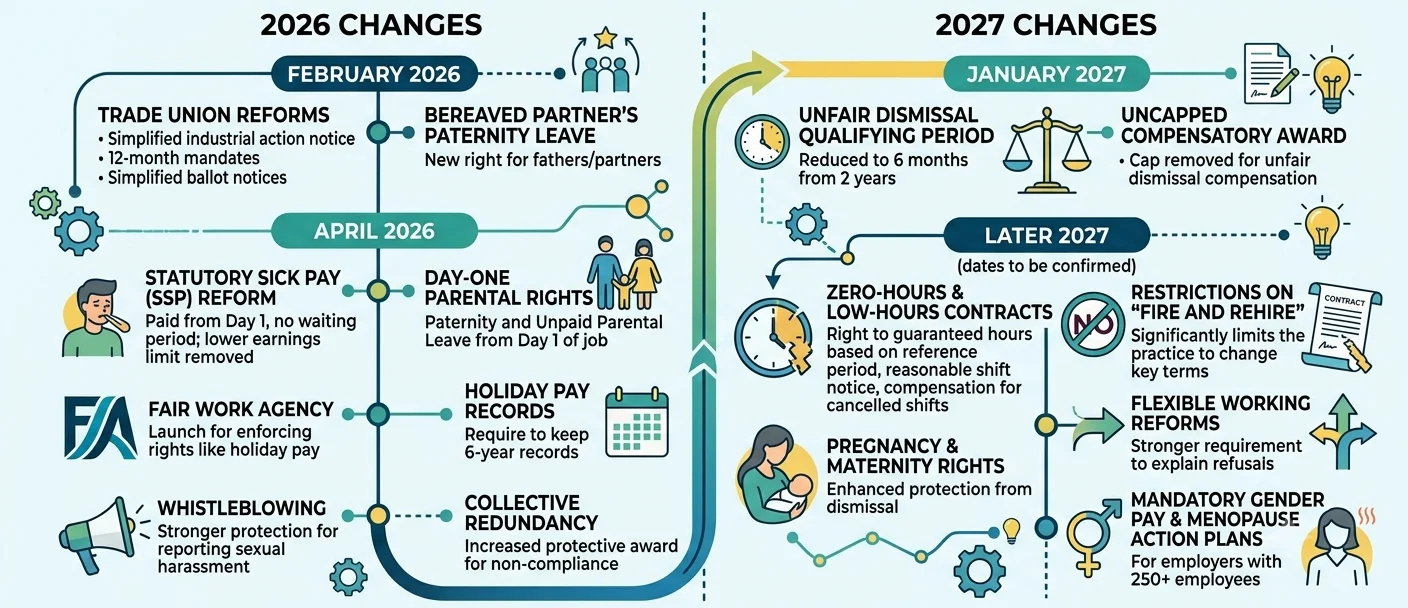
Here’s what changed in 2026, with confirmed dates:
One more major change is coming in 2027:
The Fair Work Agency, established on 7 April 2026, will enforce these rules. It can inspect workplaces, pursue unpaid wages, and bring tribunal claims on a worker’s behalf.
What goes in a contract of employment? The law splits the answer into two documents.
When must an employer hand over written terms? On day one. Not day five. Not after probation.
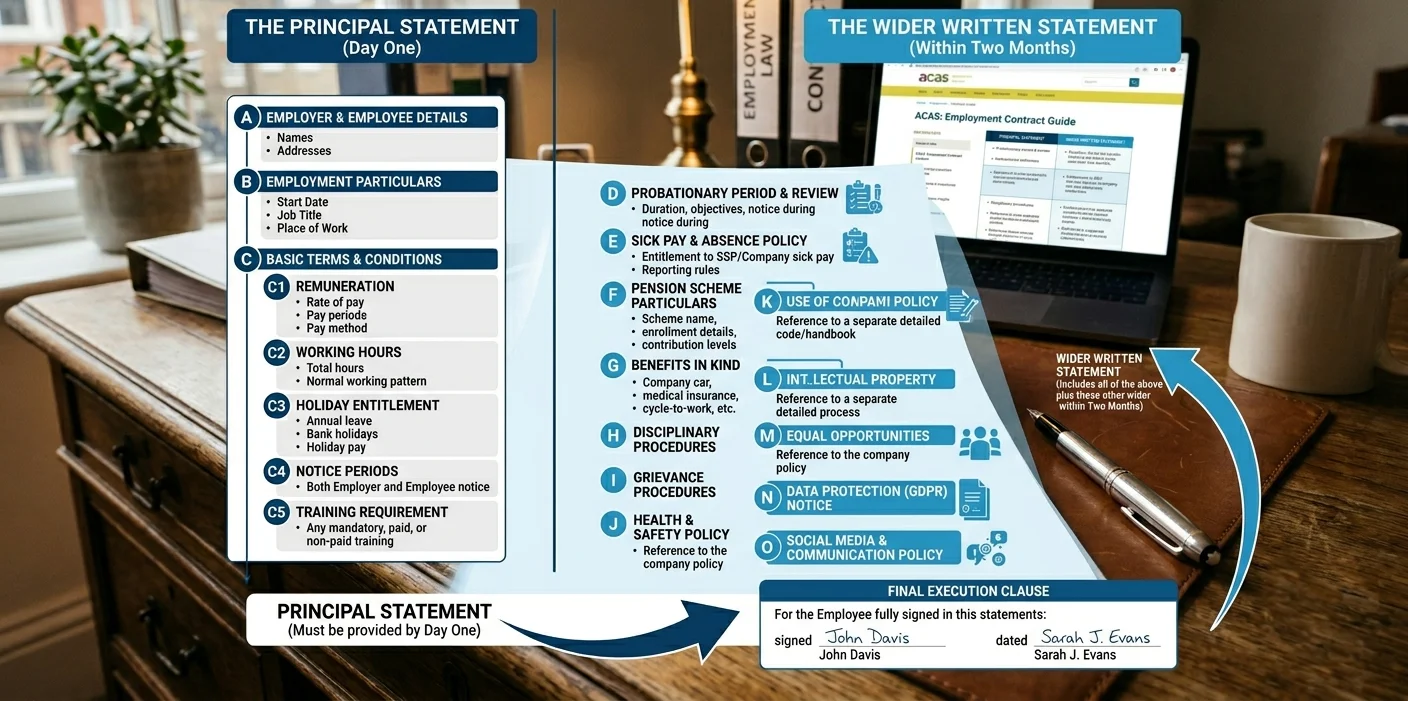
The principal statement is the core document every employer must provide on the first day of employment. A handshake won’t cut it.
It must include:
If you skip this, you’ll violate the law before the worker has had their first cup of coffee.
Some terms can follow later. Within two months of the start date, the more comprehensive written statement must be submitted.
It covers:
Two documents. Two deadlines. Both required by UK employment contract law.
A compliant contract is the bare minimum. A strong one prevents disputes.
A weak employee agreement format leaves gaps. A strong one closes them.
The best contracts go beyond the legal checklist to include:
Need a starting point? Here’s my walkthrough on creating an employee agreement format that holds up under scrutiny.
No written contract? You’re working blind.
Working without a contract doesn’t mean you have no rights. Your statutory rights still apply. But proving what was agreed becomes a nightmare.
Without written terms, you risk:
If you’ve started a job and received nothing in writing, ask for your principal statement today. It’s your legal right.
Think skipping the paperwork saves time? It costs far more later.
Working without a contract exposes a business to real financial and legal danger. The new Fair Work Agency makes that danger sharper.
The risks include:
One holiday pay case recently cost an employer £390,000 (LinkedIn, Bobby Ahmed, 2026). Records and contracts aren’t admin. They’re protection.
When did you last check your contracts? If you can’t remember, that’s the problem.
An outdated contract of employment template is a liability. The 2026 changes made many existing templates non-compliant overnight.
Run a quick audit:
Reacting late is expensive. Preparing early is cheap.
The biggest change is still coming. Unfair dismissal protection after six months arrives on 1 January 2027. That gives you time to fix your processes now.
Before then:
A guessed template is a gamble. A compliant one is peace of mind.
Don’t build your contracts from a decade-old Word file. Use an employee agreement format that reflects current UK employment contract law and the staged Employment Rights Act 2025 changes.
Want help getting it right? Start with my guide on staying compliant with UK employment contract law.
UK employment contract law changed more in 2026 than it had in years. The principal statement on day one. The wider statement within two months. Day-one sick pay and parental leave. Six-year holiday records.
These aren’t suggestions. They’re requirements with real penalties behind them.
If you’re an employee, check that you’ve received your written terms. If you run a business, audit your contract of employment template this week, not next quarter.
Found this useful? Share it with someone who’s hiring or starting a new job. Then take one action from this guide today.
A contract exists the moment you accept a job, even without writing. But under UK employment contract law, your employer must give you a written principal statement on your first day, and a wider written statement within two months.
The principal statement must cover names, start date, pay, working hours, holiday entitlement, job title, place of work, and any probation period. Employers must provide it on day one of employment.
Working without a contract doesn’t remove your statutory rights, but it makes disputes harder to resolve. Without written terms, proving agreed pay, hours, or notice periods becomes difficult for both employees and employers.
From 6 April 2026, Statutory Sick Pay applies from day one, paternity and unpaid parental leave became day-one rights, and employers must keep holiday records for six years. From October 2026, tribunal time limits extend to six months and employer liability for third-party harassment begins.
The two-year qualifying period for unfair dismissal protection will be reduced to six months on January 1, 2027. The government estimates this will protect a further 6.3 million employees (Jones Day, 2026).
The Fair Work Agency, established on 7 April 2026, enforces UK employment rights. It can inspect workplaces, pursue unpaid wages and holiday pay, bring tribunal claims on a worker’s behalf, and publicly name employers who breach the law.